
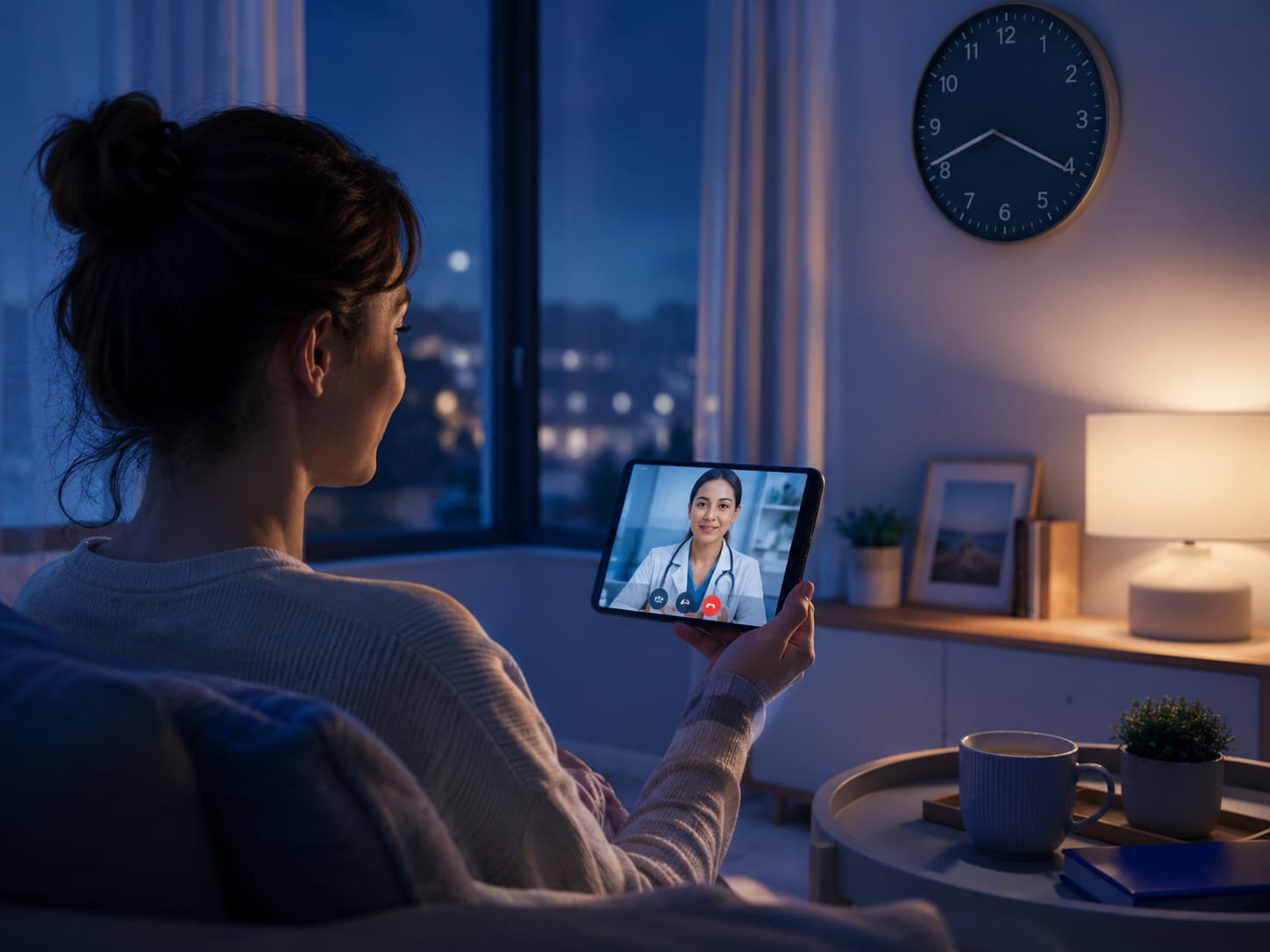
Most health concerns don’t follow business hours. You may have a sore throat that starts at 7 pm, a medication question that surfaces on a Sunday, or a child with a mild fever on a public holiday. These are the moments when after-hours telehealth becomes helpful rather than an emergency checkup.
An after-hours telehealth appointment is a GP consultation by phone or video outside normal clinic hours. It suits concerns that are uncomfortable or time-sensitive but don’t require a physical examination, hands-on assessment, or emergency care. Once your GP determines that a physical examination is not required, telehealth is easily the best option for diagnosis, treatment, and prevention.
A useful way to think about it: after-hours telehealth is for problems that feel wrong to leave until morning but aren’t severe enough to warrant an emergency department visit. It bridges the space between waiting and escalating, and knowing when it applies can save you a long night in a waiting room.
What Counts as After-Hours?
After-hours refers to times outside standard weekday clinic hours, including evenings, weekends, and public holidays. Some GP clinics offer selected after-hours sessions and dedicated online services in evenings or 7 days a week. After-hours availability is not guaranteed at every practice. Before booking, contact the clinic to confirm what is available and when.
When After-Hours Telehealth Makes Sense
The situations below suit after-hours telehealth well. Not because the concern is always minor, but because the GP can make a safe clinical decision without needing to be in the same room as you.
1. You feel unwell after work but don’t need emergency care
Cold and flu symptoms, mild fever, sore throat, cough, headache, nausea, diarrhoea, mild gastrointestinal symptoms, or a minor rash are the most common reasons people reach for after-hours telehealth, and most of the time, it is the right call.
The GP will ask when symptoms started, how severe they are, what has changed, and what medications you are taking. If the answers suggest a physical examination is needed, they will tell you. If they can assess you safely by phone or video, they will.
2. You need a repeat script, and the pharmacy closes tonight
After-hours telehealth suits repeat prescription requests when the medication is already part of your regular treatment, the condition is stable, and the GP has enough clinical history to prescribe safely. A repeat prescription through telehealth is still a clinical decision, not an automatic request for a document.
Electronic prescriptions are sent via SMS or email and can be presented at any pharmacy. The Australian Digital Health Agency confirms that during a telehealth consultation, a doctor can send an electronic prescription by SMS or email as an alternative to a paper prescription.
Please note that new medications, high-risk medicines, or controlled substances typically need an in-person review with your regular GP.
3. You need a medical certificate before work or school tomorrow
Realising at 9 pm that you are not well enough for work the next day is a common situation, and after-hours telehealth handles it well. The GP assesses your symptoms, the dates you have been unwell, your capacity to work or study, and whether a certificate is appropriate.
A certificate is not issued on request alone. It follows a proper consultation and clinical judgement. If you are unsure what wording will appear on the certificate, ask your GP at the start of the call.
4. You have a medication question that cannot wait until tomorrow
A missed dose, a mild side effect from something new, uncertainty about whether to keep taking a medication overnight, or a possible interaction with an over-the-counter medication are all time-sensitive but not life-threatening situations. After-hours telehealth handles them well.
The GP reviews your medication history, asks about symptoms, assesses risk, and advises next steps. Serious allergic reactions, facial swelling, breathing difficulty, collapse, or rapidly worsening symptoms need urgent in-person or emergency care, not a phone call.
5. You need follow-up advice after a recent appointment
If you have already seen a GP and something has changed, an after-hours call can help without having to start the whole assessment from scratch. When test results come back, a symptom shifts, or you are unsure whether treatment is working, a quick call may be enough.
This kind of follow-up works well when the GP is checking progress, clarifying instructions, or deciding whether you need to come in for a further review. It keeps care continuous without requiring another clinic visit for what may be a straightforward question.
6. Your child is mildly unwell, and you are not sure what to do
If your child feels a little sick at night, you may not know whether to wait and see or have your child seen tonight. In such a situation, booking an after-hours telehealth appointment is the best option because it gives you access to a registered GP to help you make that call.
It suits children who are mildly unwell but otherwise stable, alert, breathing normally, drinking fluids, and not worsening rapidly. The GP asks about fever, breathing, hydration, rash changes, alertness, and how things have progressed. They will advise what to monitor at home and whether an in-person review is needed.
Call 000 if your child is breathing with difficulty, unusually drowsy, showing signs of dehydration, or has had a seizure; that is a situation for emergency care and not telehealth.
7. You need a mental health check-in, but are not in immediate danger
After-hours telehealth can support a mental health check-in when there is no immediate risk of harm. This includes discussing stress, anxiety, low mood, sleep difficulty (insomnia), a medication question, or what next steps to take.
Telehealth is not crisis care. If there is an immediate risk of harm to yourself or someone else, crisis support and emergency services are the right pathway.
Lifeline is available 24 hours on 13 11 14. For emergencies, call 000.
8. You need to discuss a referral or test request
If you need to talk through a specialist referral, a pathology request, or a next step related to a result, after-hours telehealth can help. However, it requires clear clinical information, and no examination is required before the decision.
The GP needs to understand why the referral or test is needed, what symptoms are present, and what has already been investigated. A GP can arrange a referral or test request via telehealth when clinically appropriate.
When is After-Hours Telehealth Not Enough?
When a GP needs eyes, hands, equipment, or urgent monitoring to make a safe decision, after-hours telehealth is the wrong doorway. For physical examinations, vital signs, wound care, skin checks, vaccinations, procedures, and any situation where the GP cannot adequately assess you through a screen or by phone, you must visit them in person.
Do not use telehealth to test if a serious symptom is dangerous. The following symptoms need emergency care:
- Chest pain
- Breathing difficulty
- Severe pain
- Heavy bleeding
- Collapse
- Stroke symptoms
- Serious injury
- Severe allergic reaction
- Sudden weakness
- Urgent pregnancy symptoms
Call 000 immediately if someone is seriously injured, needs urgent medical help, or when life or property is in danger.
How to Prepare Before Your After-Hours Appointment?
Rather than worrying about preparing, your first step should be to book an appointment. After that, have these ready before the GP calls you:
- Working internet or phone connection
- Your Medicare card
- A list of current medications and doses
- Your allergy list
- A clear timeline of when symptoms started and how they have changed
- Any recent test results relevant to the concern
- Your pharmacy details if a script is likely
- Employer or institution requirements for a certificate if needed
For a video appointment, test the camera, microphone, internet connection, and device charge before the scheduled time. Find a quiet, private space and keep your phone nearby in case the connection switches to audio.
FAQs
Are telehealth appointments still available after hours in Australia?
Yes, after-hours telehealth is available through many Australian clinics and online providers, but availability depends on the clinic, doctor’s schedule, and appointment type. After-hours sessions are not guaranteed at every GP practice, so check the booking system or contact the clinic before relying on it.
What counts as after-hours for a telehealth appointment?
After-hours refers to times outside standard weekday clinic hours. Those include evenings, weekends, and public holidays. Some clinics offer limited sessions, and others operate extended or seven-day availability.
Is after-hours telehealth the same as urgent care?
No, after-hours telehealth is for non-emergency GP concerns that do not require physical examination. Urgent care is for problems needing faster in-person assessment, and emergency care is for serious or life-threatening symptoms. A simple guide: telehealth for GP-level advice, urgent care when you need to be seen quickly in person, and emergency care for immediate danger.
Can I get a prescription through an after-hours telehealth appointment?
Yes, when the consultation provides enough clinical information for the GP to prescribe safely. Repeat prescriptions for stable, known medications are the most suitable use case. New medications, high-risk medicines, and controlled substances typically require an in-person review with a regular GP.
Can I get a medical certificate after hours through telehealth?
Yes, a GP can issue a medical certificate after hours when the consultation supports it clinically, meaning the GP has assessed your symptoms, work capacity, and illness dates and determined a certificate is appropriate. It is not issued simply because you request one.
Can after-hours telehealth help with a child’s illness?
Yes, when the child has mild symptoms but is stable, a GP can help parents understand what to monitor, what care steps to take, and whether an in-person review is needed. Emergency care is needed if a child has breathing difficulty, severe drowsiness, signs of dehydration, a seizure, or rapidly worsening symptoms.
Is after-hours telehealth suitable for skin checks or injury assessment?
No, skin checks, mole assessment, wound care, and injury assessment require close physical inspection, touch, movement testing, or medical equipment. A GP can offer general first-step advice by phone, but a proper assessment needs to happen in person.
What do I need before and after an after-hours telehealth appointment?
Have your Medicare card, current medications, allergy list, symptom timeline, recent test results, and pharmacy details ready before the call. For video, test your camera, microphone, and internet connection beforehand and find a quiet, private space. If you need a certificate, know the dates you have been unwell and your expected return date.
What if the GP is running late?
GPs run late for the same reason they do in a clinic: the patient before you needed more time. Keep your phone nearby and stay available around your booked time. If you have not heard anything after 15 to 20 minutes past your appointment time, contact the clinic or booking provider to check the status.
What if I am not sure whether telehealth is the right option?
When in doubt, choose the safest level of care. Use telehealth for non-emergency GP advice when an examination is not needed, in-person care when symptoms require hands-on assessment, and emergency care when symptoms are severe, sudden, or rapidly worsening. If something feels serious, do not wait for a telehealth appointment to confirm it.


Comments are closed